
How Kotomi Swim achieved a 10% conversion rate on Bidit enabled products
Kotomi Swim is a Melbourne label that draws its own prints and cuts them into swimwear made for a long Australian summer, sold direct across Australia and shipped worldwide.

Results
Reporting period: 27 April – 21 September 2026One in ten shoppers who opened Bidit went on to buy. Kotomi changed no price, no print and no product page to get there.
Offers settled 3% above the lowest price Kotomi had agreed to take. The floor held on every sale, so the margin moved up rather than down.
For every dollar a shopper offered on, they added another 53 cents of product to the order, that’s what Bidit does that people don’t even realise, gets people to add more to the basket.
“Our customers take their time. They will sit on a piece for weeks, and we were never sure whether it was the fit, the print or the price stopping them. Bidit lets them tell us quietly what feels right, and we decide what we can accept. We get the sale without hanging a sale banner over the whole site and teaching everyone to wait.”
Overview
One in ten Kotomi Swim shoppers who opened Bidit went on to place an order.
Those orders settled above the lowest price the brand had agreed to take, and they carried more than the piece that was offered on. Kotomi ran no public sale to produce any of it.
Three things moved when Bidit went on. Where the price conversation happens, who sets the number, and what a hesitating shopper does instead of leaving. Everything below follows from those three.
SolutionWhy Kotomi Swim started using Bidit
Swimwear asks more of a shopper than almost anything else in fashion. People have to picture themselves in it, in daylight, in front of others. So they take their time. They open the same print on Tuesday and again on Thursday, read the size guide twice, check where the ties sit. Interest is rarely the thing that is missing.
Kotomi had already dealt with the part of that hesitation it could reach. Try Before You Buy lets a shopper take up to eight pieces home and pay for nothing until they have decided what stays. Fit stopped being a reason to leave. Price did not.
The brand is strong at the top of the funnel. The prints are drawn in house and they travel on social, the following grew largely by word of mouth, and paid campaigns on Google and Meta bring in the rest. The gap sat further down, among the people who had already chosen a piece and still closed the tab.
Bidit sits on the product page, which is where that decision actually gets made. Someone looking at the piece they want is as close to buying as they will ever be, and they are one step from checkout. Bidit gives them a private way to say what they would pay, and gives Kotomi a set of rules that answers them without anyone at the brand lifting a finger.
The conversation now happens while the print is still on the screen, rather than in an email the following Tuesday, or not at all.
One in ten shoppers who opened Bidit went on to buy, meaning Kotomi is gaining incremental sales from those customers who would have left that bikini on the product page.
How Bidit works
The first question any retailer asks is whether this is discounting in a disguise.
It is not, because the merchant writes the rules before a single offer arrives. Kotomi set a floor under every enabled product. Offers above it clear instantly. Offers below it come back with a counter rather than a refusal, which keeps the shopper in the conversation without conceding anything. Nothing is advertised, no code changes hands, and the price on the site never moves.
The offer window is styled to the store it sits in, so on Kotomi it reads as part of the site rather than something bolted on.
Across the period, shoppers settled 3% above the lowest price Kotomi had agreed to accept. Every sale cleared the floor, which makes that figure margin added rather than margin surrendered.
In a category that runs on seasonal markdowns, the distinction is the entire argument. Swim customers know an end of summer sale is coming and a good number of them simply wait for it. A private offer takes the sale now, at a number the brand chose, without publishing a reason for everybody else to hold off.
The personalisation of Bidit
It is Sunday night. A shopper opens a bikini top they have already looked at three times this fortnight. They know the print. They have settled on the size. They are still not sure about $89.
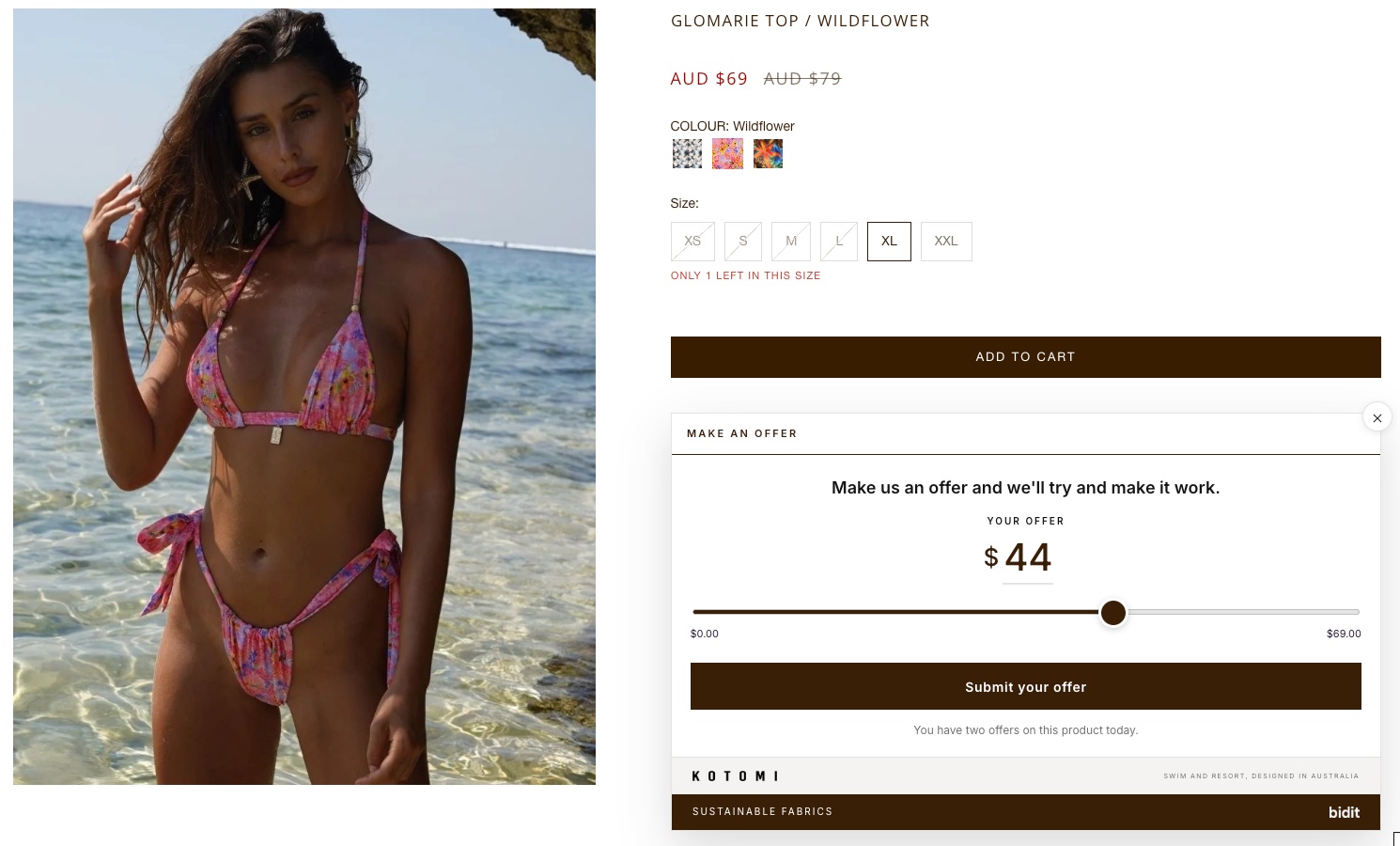
They offer $70. The rules read it, place it under the floor, and come back at $79 before they have moved the cursor. No email, no waiting, nobody at Kotomi involved.
They take it, add the matching bottoms on the way through, and pay in the same session.
Kotomi never ran a sale. Nobody else ever saw $79. A shopper who was leaving did not leave.
That conversation ran over and over between 27 April and 21 September 2026.
How Bidit helps shoppers spend more
The fear is that handing a shopper the price hands them the whole basket, and they walk away with the cheapest version of what they came for.
Kotomi’s orders say otherwise. For every dollar shoppers offered on, they put another 53 cents of product into the same order without making an offer on it at all.
Swim sells in halves, which explains part of it. The rest is simpler. A shopper who has just been met on price is in a buying mood rather than a bargaining one, and the second piece never gets the scrutiny the first one did.
The Results
27 April to 21 September 2026:
- One in ten shoppers who opened Bidit went on to buy
- Offers settled 3% above the lowest price Kotomi had agreed to take, lifting margin on every one of those orders
- For every dollar offered on, shoppers added another 53 cents of product to the same order
- No public sale, no code, and no change to the price on the site
What’s next
Kotomi is widening the range of products that carry an offer, starting with the parts of a swim catalogue that are hardest to shift on price alone. Last season’s colourways. The one off prints. The sizes at either end of the run that every label ends up holding. New season stock comes next, which is the part most merchants miss: Bidit is not a clearance tool. It works anywhere a shopper has decided they want something and stalled.
The part the team did not expect was the reporting. Store data and offer data sit together in one place, which shows the brand what its customers will genuinely pay for a given piece. Most retailers never get that number. They only ever see the ones who said yes.
For Kotomi, the lesson is the one that travels to any retailer. The shoppers who were going to leave over price now have somewhere else to go, and it is not a competitor.